
I Watched a Game Economy Collapse in Two Hours and Now I Can't Stop Thinking About Resource Loops
I Watched a Game Economy Collapse in Two Hours and Now I Can't Stop Thinking About Resource Loops There's this game called TBH: Taskbar Hero. PC game,
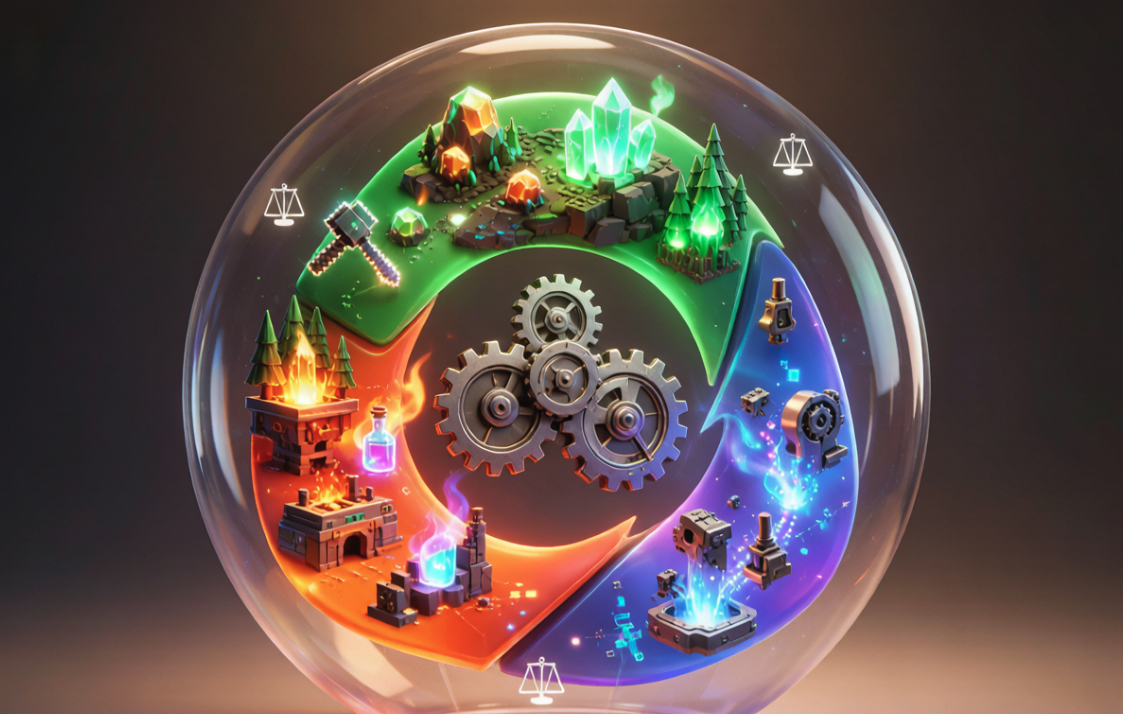
I Watched a Game Economy Collapse in Two Hours and Now I Can't Stop Thinking About Resource Loops
There's this game called TBH: Taskbar Hero. PC game, idle stuff, integrated with the Steam community market so you could sell your drops for actual wallet funds. Clever idea. Worked fine for a while.
Then the market went down for 18 days. Technical issues, nothing dramatic.
When it came back online? The entire economy collapsed in under two hours.
I'm not exaggerating. Prices cratered to basically zero. Supply flooded in from two and a half weeks of unchecked generation. Nobody wanted to buy. Everybody wanted to sell. The whole thing turned into what people on the forums started calling a "single-sided sell-off"—which is one of those phrases that sounds clinical until you realize it means a room full of people screaming "SELL" into a void where no buyers exist.
And here's the thing that's been eating at me: this outcome was predictable. Not in a "well, in hindsight" way. In a "the resource cycle had a hole you could drive a truck through and nobody dealing with the shutdown thought about it" way.
So let's talk about resource cycles. Not because they're elegant or interesting in the abstract. Because when they break, they break spectacularly, and the people who get hurt aren't the designers—it's the players who trusted the system enough to spend time in it.
The Producer-Consumer Thing (Which Is Less Complicated Than It Sounds)
Okay, so what even is a resource cycle.
At the most basic level, it's: stuff enters the economy → stuff gets used up or transformed → whatever's left either goes somewhere useful or clogs everything up. Game design textbooks call this the Producer-Consumer pattern. Fancy name. Simple idea.
A producer makes resources. Quests, loot drops, daily login rewards, the iron ore node that respawns every three minutes. A consumer removes or transforms them. Crafting that sword, upgrading your base, the repair costs on your armor that you swear are getting more expensive every patch.
Most games have a bunch of these chains running on top of each other, overlapping in ways the player probably never thinks about. Gold flows from quests into the auction house. Crafting materials flow from gathering nodes into gear, then that gear eventually becomes... what, exactly? Vendor trash? Disenchant fodder? That's the recycling question, and we'll get to it.
The danger zone—and this is where the TBH thing becomes relevant—is when one node in this network becomes a bottleneck. Not enough of something, and progress grinds to a halt. Too much of something, and it becomes worthless. Both outcomes make players miserable, just in different flavors.
People draw resource flow diagrams for this stuff. I've seen them. They look like someone tried to map the London Underground while drunk. Arrows everywhere. Boxes labeled things like "SOUL ASH ACCUMULATION (PRE-CONVERSION)" and "CRAFTING MATERIAL SINKS (T2-T4 ONLY)". The goal is to make sure nothing in that diagram is either starved or drowning.
Sounds simple. It is not simple.
Three Things That All Have to Work, or Nothing Does
A functioning game economy rests on three pillars. If any one of them collapses, the whole thing tips over. I've seen all three fail, in different games, and the results range from "mildly annoying" to "the entire player base rage-quit over a weekend."
Production: How Stuff Enters the World
Production is just "where resources come from." Renewable nodes. Quest rewards. The goblin that drops 12 copper every time you kill it. Time-gated accumulation where you log in and a timer says "here's your daily allotment of star dust, enjoy."
Games also use converters—things that turn Resource A into Resource B. Your iron ore becomes iron bars becomes steel becomes a sword. Each step is a production event that creates something new. The question every designer has to answer is: how much of each resource enters the economy per hour of gameplay?
Get this wrong and you've already lost. Too little? Players complain the game is stingy and the grind feels disrespectful. Too much? Congratulations, you've invented inflation, and now your gold is worth less than the pixels it's printed on. Players stop caring about rewards because rewards don't mean anything anymore.
I've been in MMOs where veteran players had more gold than they could ever spend—literally billions—and the economy had basically bifurcated into a two-tier system where new players used gold and veterans bartered in rare materials because gold had become a rounding error. That's not a functioning economy. That's a museum of past mistakes.
Consumption: Where Stuff Goes to Die (Hopefully)
Consumption is the flip side. You spend currency on upgrades. You craft items that use up materials. You chug that health potion mid-fight. All of that removes resources from circulation.
If production outruns consumption, you get inflation, and everything I just said about gold becoming meaningless applies here too. The most dangerous thing a game economy can do is produce more than it can burn.
But here's the subtle part—consumption has to feel worth it. If the game just taxes you 5% of your gold every time you fast-travel, nobody's going to think "ah yes, an elegantly designed economic sink." They're going to think the game is nickel-and-diming them. The best consumption systems are the ones players actively want to participate in. That cool upgrade. That limited-edition cosmetic. That thing that makes your numbers go up in a satisfying way.
The cost has to be high enough that you think about it. If everything's so cheap that you never have to choose between Option A and Option B, your resources don't have tension. And tension—that moment of "do I buy this now or save for that later"—is what makes an economy feel alive.
Recycling: The One Everyone Forgets About
Recycling is the red-headed stepchild of game economy design. Everyone remembers to build production and consumption. Almost nobody remembers to build a way for old stuff to become useful again.
Here's what happens in a game with no recycling: you outlevel your sword. What do you do with it? Vendor it for 12 gold. That's not recycling—that's deletion with a tiny consolation prize. You've lost 95% of the value you invested in that item, and the materials that went into making it are just... gone. Extracted from the economy with no return path.
After enough of this, players start hoarding. They keep old gear "just in case." Their inventories are graveyards of obsolete items they can't bring themselves to delete because deleting feels like admitting they wasted their time earning them. I have a friend—no, I'm not naming them—whose MMO bank has items from three expansions ago. They will never use these items. They know this. And they still can't delete them.
Good recycling systems offer a partial return. You dismantle the old sword and get back, say, 40% of the materials. You lose something—that's the cost of upgrading—but you don't lose everything. The materials re-enter the economy, become part of the next thing you craft, and the cycle stays fluid.
The keyword there is partial. If recycling gives you a 100% return, congratulations, you've just created a net-positive loop where nothing is ever truly consumed and the economy drowns in infinite resources. Same thing happens if recycling somehow outputs more than what went in. I've seen games patch this exact bug—players discovered that disenchanting Item A and crafting Item B from the results produced more value than Item A was worth, and within 48 hours the economy was a smoking crater.
What Happens When All Three Break at Once
Let's go back to TBH, because it's a perfect—and I mean textbook-perfect—case study in how fast things can unravel.
The setup was smart: players could earn tradeable assets through idle gameplay and sell them on Steam's market for real money. This created a closed loop where playing → earning → selling → buying. The game took a transaction fee. Everyone was theoretically happy.
Then the market went dark for 18 days.
During those 18 days, here's what happened:
Production kept going. The idle gameplay didn't stop. Players' machines kept generating resources 24/7. Nothing could be sold, sure, but everything was still being created. By the time the market reopened, there was a tsunami of backed-up supply waiting to crash onto the marketplace. Imagine every factory in a country running at full capacity for two and a half weeks while all the stores were closed. That's what this was.
There was no recycling mechanism. Zero. The surplus resources had nowhere to go. You couldn't convert them into anything useful. You couldn't consume them for progression. They just sat there, dead weight, waiting to be sold. And when selling became impossible because nobody was buying, they became dead weight forever. The economy had a one-way valve into oblivion and nothing to pump things back.
Cheating tools made everything worse. During the shutdown, people using automation tools flooded the production pipeline with high-value items. The supply wasn't just backed up from normal play—it was artificially inflated on top of that, and the game had no way to filter legitimate supply from botted supply.
Anti-fraud measures froze the market. The protections designed to stop automated selling also stopped real players from adjusting their prices. You couldn't undercut. You couldn't react to the crash. The market was in gridlock, prices plummeting, and honest players were locked out of the only mechanism that might have let them salvage something.
Result: hyperinflation in reverse. Prices hit near-zero. Demand evaporated. The whole thing became a fire sale where everyone wanted to exit and nobody wanted to enter. Community trust, which had taken months to build, collapsed in hours. Players who'd invested real time and real money into the ecosystem walked away. Some of them probably uninstalled and never looked back.
All because nobody asked: "what happens to production if the market goes down? What happens to excess supply if there's nowhere to put it? What happens if cheating spikes supply right when demand is frozen?"
Three pillars. All three broke. The roof caved in.
The Blockchain Experiment (Or: When Recycling Gets a White Paper)
Some projects have tried to solve the recycling problem by building it directly into the economic architecture using blockchain. The MapleStory Universe project is one of the more interesting attempts I've come across.
The setup uses three asset types: NXPC (the primary currency, with capped total supply), NESO (an in-game currency pegged to NXPC at a fixed rate), and NFTs representing in-game items. The key constraint: the total possible supply of everything is ultimately capped by the NXPC supply. You can't inflate your way out of problems because there's a hard ceiling on how much can exist.
The recycling mechanism is what they call "item fusion." Players sell unwanted NFTs back to a bid pool that calculates prices using a weighted average from the secondary market. This creates a floor—your garbage item is worth something because the pool will always buy it, even if the open market won't. There's also a one-way conversion: NXPC → NFTs. Always consuming the primary currency, always producing new assets. The flow goes in one direction, which prevents the infinite-loop problem I mentioned earlier.
It's clever. It's also, uh, not without risks—and the project's own documentation admits this. When players can optimize for NXPC yield, they might do that instead of actually playing the game. The diversity of the experience shrinks. The world becomes a spreadsheet with graphics. Players who came for the game stay for the arbitrage, and eventually the game part just... withers.
That's the dark side of formalizing recycling—you risk creating an economy so efficient that it eats the game it was built to serve.
The underlying rule doesn't change, regardless of whether you're using blockchain or a SQL database or literal pen and paper: production can never be cheaper than consumption, and recycling must give a return without creating a loop that generates value from nothing. A net-positive cycle—turn gold into essence, essence back into gold, walk away with more than you started—is economic poison. It's a perpetual motion machine for resources, and the moment players find one, your economy is dead.
The Closed Loop: What Actually Works
The economies that survive, in my experience, all share one structural thing: they're closed loops. Stuff comes in. It gets transformed. It gets used up. The leftovers feed back into new production. The circle closes.
Factorio makes this explicit. You literally build the loops yourself. Iron ore → plates → gears → machines that mine more iron ore faster. Every output is an input for something else. The early game is manual labor that makes you feel invested, the mid-game is automation that gives you that dopamine hit of watching your factory run itself, and the late game is optimization—making the loops tighter, faster, more efficient. People lose entire weekends to this game. Entire weeks. The loop just... keeps... going.
Idle games flatten the cycle into something simpler. Production is automated by default. Consumption is gated behind upgrades that get exponentially more expensive. Recycling happens through prestige mechanics—you reset your progress, but you keep some multiplier or bonus that makes the next run faster. The challenge in idle game design is threading this needle: players always need to have something worth spending on, but they can never accumulate so much that resources lose all meaning.
It's harder than it sounds. I've played idle games where I hit a wall and suddenly had nothing to do but wait. No decisions. No spending. Just... waiting. That's not a game anymore. That's a screensaver with a progress bar.
Where I Land on This
So here's what I keep coming back to, after the TBH thing and the blockchain experiments and all the Factorio binges:
The resource cycle is the skeleton. Production has to match the pace of consumption. Consumption has to feel like a choice, not a tax. Recycling has to exist—it can't be an afterthought bolted on in a patch three years after launch. And none of the three can create a loop that generates value from nothing, because the moment that happens, your economy is running on borrowed time.
The TBH crash wasn't a freak accident. It was an inevitable consequence of a system where production and consumption couldn't compensate for each other under stress, and where recycling simply didn't exist. Eighteen days. That's all it took.
The MapleStory Universe model is a more formal approach—capped supply, guaranteed buyback, one-way conversions—but whether it actually works at scale depends entirely on whether players keep playing the game instead of playing the economy. That's not a technology question. It's a human behavior question, and those are always harder.
Here's the part I think gets missed in a lot of design discussions: a resource cycle isn't just math. It's psychology. Players need to feel that their time means something, that their resources have weight, and that the system isn't rigged. When the cycle works, nobody notices it. They just play. They make decisions. They feel good about their progression.
When it breaks? They notice immediately. And they don't come back.
And that's the thing about the TBH players who uninstalled. The game didn't just lose their accounts. It lost their trust. You can patch an economy. Patching trust is a whole different problem, and I'm not sure it's one any hotfix has ever really solved.
Original Content Declaration — This article was written by the appdgg Editorial Team and represents original work created through independent research and firsthand gameplay experience. Last updated: July 2026.
Other content
This Retro Gaming Monitor Let Me Relive the 90s Summers
There is a specific smell that belongs to a summer afternoon in the 1990s. It's a mix of hot asphalt, grass someone just mowed, and the warm electrica
Assassin's Creed Shadows Ended Up Great–If You Played All The DLC
I'll say something that might get me looked at sideways by certain corners of the fanbase. I think Assassin's Creed Shadows is genuinely good. Maybe e
Splatoon Raiders Is A Bold Rethink Of What Makes A Splatoon Game
Splatoon Raiders Flips the Series on Its Head, and That's Exactly the Point For close to ten years, Splatoon has meant one thing to most players. Comp
Prime Slimes: A Guide To Gaming's Greatest Goo-Getters
Prime Slimes: A Guide to Gaming's Greatest Goo-Getters There is something weirdly satisfying about a good slime. Maybe it's the way they jiggle when t