
Prime Slimes: A Guide To Gaming's Greatest Goo-Getters
Prime Slimes: A Guide to Gaming's Greatest Goo-Getters There is something weirdly satisfying about a good slime. Maybe it's the way they jiggle when t
Prime Slimes: A Guide to Gaming's Greatest Goo-Getters
There is something weirdly satisfying about a good slime. Maybe it's the way they jiggle when they move. Maybe it's the wet squelch when you finally beat one. Or maybe it's simpler than that. These formless blobs of goo have somehow become one of the most durable and loved creature types in all of gaming. They started as dungeon hazards, turned into mascots, and eventually became playable heroes. Four decades in, they're still everywhere.
I've spent more time than I'd like to admit thinking about slime characters. Not in a strange way. It's just that there's real craft in what developers have done with the simplest possible idea, a lump of goo, and turned it into something that can be scary, cute, or genuinely clever to play. So let's run through the best specimens, from the old-school traps to the weirdos and the newcomers.
The ancestor that started it all
Before video games had slimes, tabletop did. The Gelatinous Cube showed up in the original Dungeons & Dragons Monster Manual back in 1974. It's a ten foot cube of transparent digestive fluid that slides silently down dungeon halls and dissolves whatever organic matter it touches. The terror was in the simplicity. It was nearly invisible, so if you weren't paying attention, you could walk straight into a slow, sticky death.
What kept the Cube alive in people's minds wasn't how dangerous it was. It was how strange it was. A cube. Made of jelly. That eats things. The idea was so dumb it looped back around to iconic. Later games softened the slime into something friendlier, but the Cube is still the original ooze everything else came from. You can draw a straight line from a 1974 trap to the mascots on store shelves now.
The one everyone actually loves
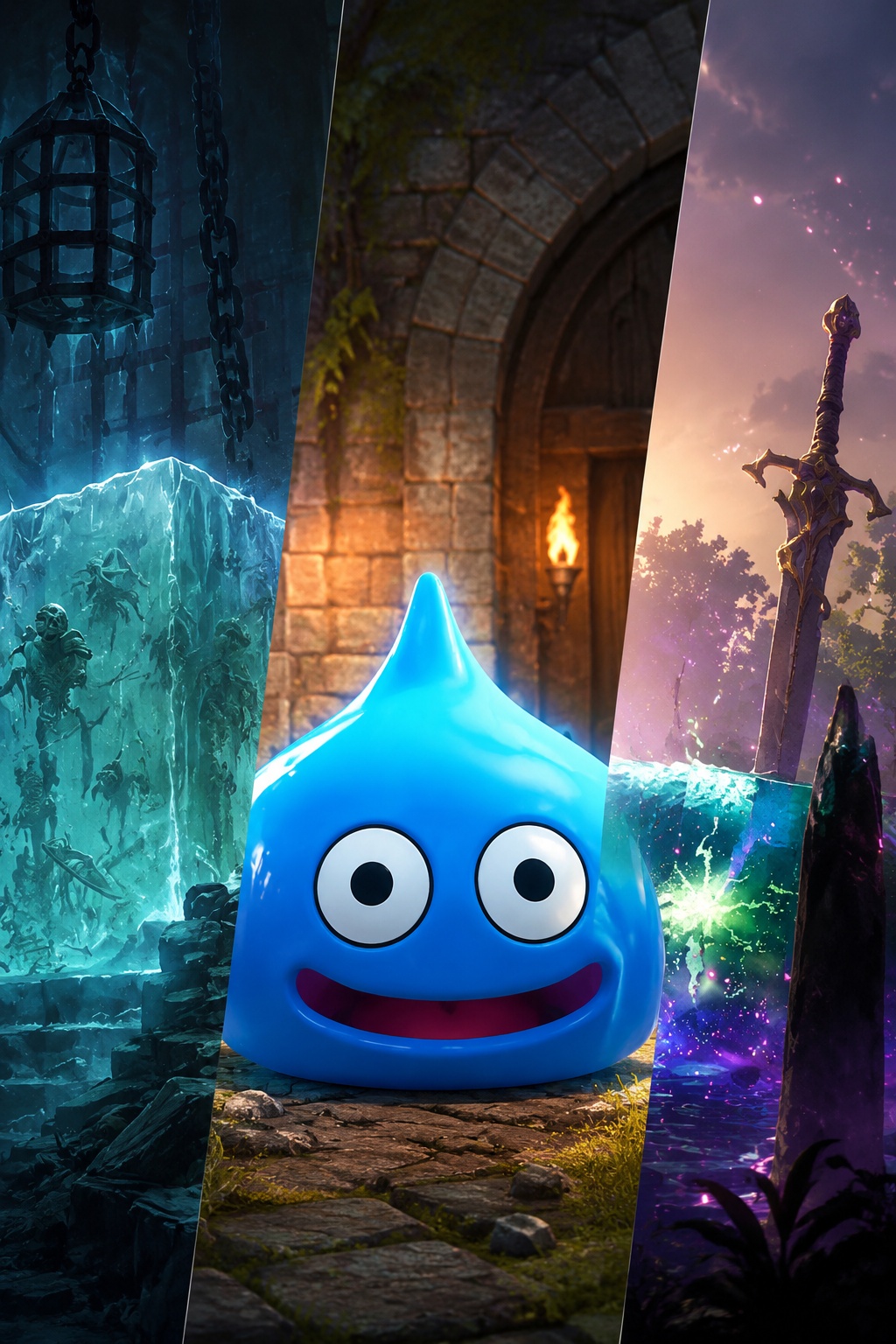
If the Cube is the grandfather, the Dragon Quest slime is the family favorite everybody wants a plush of. When Yuji Horii designed the monster for the first game in 1986, he deliberately pulled away from anything gross. Instead of a nasty sludge pile, he made a teardrop shaped, baby blue blob with a permanent dumb grin. That smile was the smart part. It made the creature so likable that players almost felt bad farming it for experience.
Over time that little blue guy became the face of the whole franchise, outshining most of the human cast. It's been on merchandise, in spin-off games, and my personal favorite, Rocket Slime on the DS, is still a cult classic worth tracking down. The Dragon Quest slime taught the industry a lesson that stuck: monsters don't have to be frightening to be memorable. They just need a personality you can recognize in a second.
The weird ones that leaned into gross
Not every slime went cute. Final Fantasy gave us Flans, blobby things with googly eyes and toothy snarls that managed to be silly and uncomfortable at the same time. Shin Megami Tensei kept its slime demons ugly on purpose, leaning back into the old idea of ooze as something corrupting and consuming. Those games reminded players that the goo could still be unsettling if a designer wanted it to be.
Then there's The Ooze, a 1995 Sega Genesis game where you played as Dr. Caine, a scientist turned into a puddle of bubbling green goo after he found out his employer was poisoning the planet. The controls were clumsy and the mechanics fought you, but the point stands. It proved a slime could carry an entire game as the lead. It was strange, ambitious, and very much a product of the weird experimental 16 bit era, and I'm glad it exists even if I'd never call it polished.
The indie scene fell in love with goo
If any corner of gaming is doing the most interesting slime work right now, it's the indies. World of Goo, from 2008, turned slimes into physics puzzle blocks, and you built towers and bridges out of living globs. Slime Rancher took the opposite approach with a calm farming sim where you raise, feed, and breed adorable slimes on alien planets, a gentle, colorful break from the usual violence. Slime Heroes went further and made a co-op soulslike with cutesy looks, proving difficulty and squishy heroes can sit in the same game. And there's Asher Zhu, an indie artist whose in-development 3D slime game is already turning heads with how good it looks.
What these games get is that slimes aren't just enemies to clear off a map. They're a tool for clever mechanics, for emotional connection, and for plain charm. When the creature is that flexible, a developer can build almost anything around it.
The new guy everyone's talking about
That brings us to the latest slime to blow up: Phranque, the wobbly square blob from God of War Laufey. Jack Quaid voices him in what might be the most ridiculous motion capture setup ever filmed, and Phranque stole the reveal trailer outright. He's spinning like a whirlwind, mowing down enemies, and winning over people who showed up for the serious stuff. He isn't even the main character, but he became the most talked-about part of the showcase within a day.
His sudden fame isn't only about Quaid's funny performance or the physics defying moves, though both help. It's about what he stands for. The slime archetype just keeps working. In a series known for grim, heavy drama, a square of goo crashing the party feels like a relief. He's proof that even in the most serious game, a little nonsense can walk off with the room.
Why slimes never go away
So why do they last? I think it's because they're a blank canvas. The shapeless form lets a designer drop any personality on top, cheerful, threatening, silly, or sad. They're simple enough to fit any world but distinct enough to stick in your memory. They can be the enemy, the friend, the puzzle piece, or the actual tool you use to solve a problem.
There's a practical side too. Slimes are cheap to animate well. Their squishy, bendable bodies hide the small flaws that would ruin a human character. They're easy on the hardware, easy to read on screen, and satisfying to watch move. And the moment you beat one, that splat, that bounce, that dissolving gurgle, is a tiny hit of joy every time. Developers noticed that early and never let go.
A few you should actually play
If this got you interested, don't just read about them. Rocket Slime on DS is the easiest recommendation, a charming little action game with real heart. World of Goo is on basically everything and still holds up as a puzzle game. Slime Rancher is the one to grab if you want something calm after a long day. And keep an eye on Asher Zhu's project if you want to see where the look of these creatures is heading next. The Dragon Quest slime games and crossovers are worth a look too if you've never understood why that blue blob has such a grip on people.
The throughline
From the Gelatinous Cube to Phranque, slimes have shown they might be the most adaptable creature type gaming ever made. They've been the foe and the friend, the obstacle and the companion, the mascot and the punching bag. They've led their own games and stolen scenes from gods. They jiggle, they squelch, they grin, and without fail they get us to grin back.
I don't expect that to change. As long as there are developers who want a creature that can be anything, the slime will be there, wobbling, waiting, and ready to be whatever the next game needs it to be. That's a better legacy than most monster types ever get, and it's one they earned one satisfying splat at a time.
Original Content Declaration — This article was written by the appdgg Editorial Team and represents original work created through independent research and firsthand gameplay experience. Last updated: April 2026.
Other content
This Retro Gaming Monitor Let Me Relive the 90s Summers
There is a specific smell that belongs to a summer afternoon in the 1990s. It's a mix of hot asphalt, grass someone just mowed, and the warm electrica
Assassin's Creed Shadows Ended Up Great–If You Played All The DLC
I'll say something that might get me looked at sideways by certain corners of the fanbase. I think Assassin's Creed Shadows is genuinely good. Maybe e
Splatoon Raiders Is A Bold Rethink Of What Makes A Splatoon Game
Splatoon Raiders Flips the Series on Its Head, and That's Exactly the Point For close to ten years, Splatoon has meant one thing to most players. Comp

GameStop Is Not Hurting After Sony Kills Discs, And There Is A Good Reason Why
When Sony said it would stop making physical discs for all new PlayStation games starting in January 2028, the obvious take was that GameStop was in t