
This Retro Gaming Monitor Let Me Relive the 90s Summers
There is a specific smell that belongs to a summer afternoon in the 1990s. It's a mix of hot asphalt, grass someone just mowed, and the warm electrica
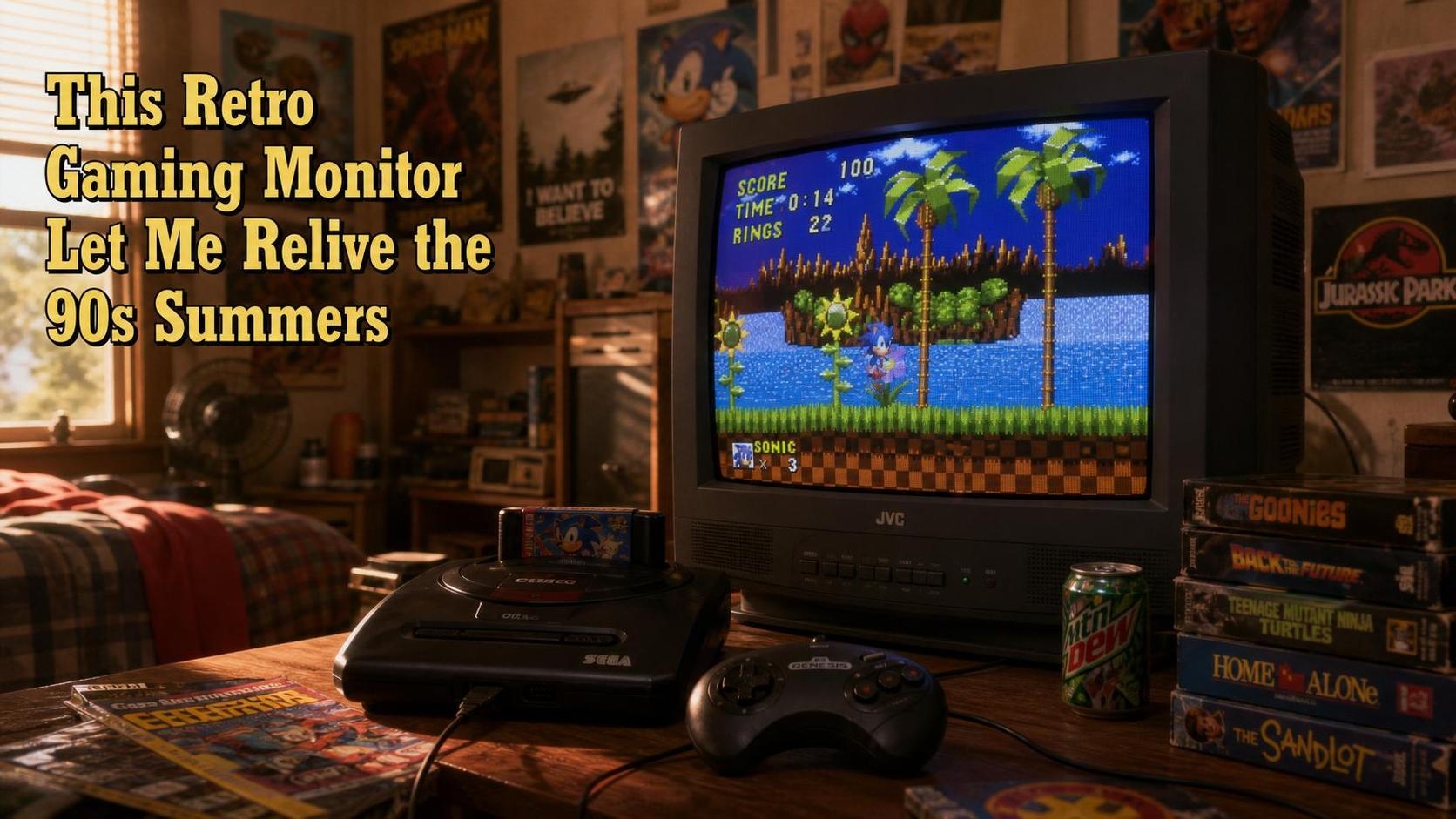
There is a specific smell that belongs to a summer afternoon in the 1990s. It's a mix of hot asphalt, grass someone just mowed, and the warm electrical scent coming off a CRT TV that's been running since breakfast. I used to lie on the carpet with my chin in my hands, squinting at a 21 inch screen while my thumbs hammered the controller. Outside it was bright and loud. Inside, in the dim living room, I was in Hyrule, or flying through Green Hill Zone, or getting shot at in some space game I've since forgotten the name of. Those summers felt like they would never end.
Now, thirty years later, I have a 4K OLED with HDR, 144Hz, and a picture so clean it's almost sterile. It's an amazing piece of hardware. It has never once made me feel like a kid again. Not once. Then I plugged in a retro gaming monitor that does exactly one thing, it shows old consoles the way they were actually built to look, and something shifted.
I want to be clear about what this is. It is not a filter. It's not a scanline overlay you turn on in RetroArch, not a shader, not a trick. It's a real display, made with the same basic technology as the CRTs from back then, but built for modern cables and made to not fall apart. I hooked up my original Super Nintendo with composite cables, turned it on, and the screen came up with that familiar buzzy hum. For the first time in years I wasn't looking at a game. I was inside it.
Modern screens lie to old consoles
Today's monitors are built for high definition. They're great with 4K movies, websites, and the photorealistic stuff that comes out now. They fall apart with the 240p and 480i signals that 16 bit and 32 bit consoles push out. To fill the panel they upscale, they interpolate, they smooth everything. You get a picture that's sharp and completely dead. The pixels turn into hard little squares. The colors lose the soft bleed they used to have. The tiny flicker that once made sprites feel like they were moving is just gone.
Here's the part most people don't get. The developers in the 90s were counting on the flaws in CRTs. They used the scanlines to add depth. They used the color blooming to fake lighting. They used the slight warping at the edges to make text and characters look more alive. When you run Super Mario World on a 4K set, every pixel is a perfect square, and you lose the feeling that the world is breathing. It becomes a grid. A clean, correct, boring grid.
The retro monitor does the opposite. It doesn't try to make the image better. It just plays the analogue signal back the way it was meant to be played. The scanlines are there, faint but real. The colors are rich and a little warm, exactly like they were when I was nine. And the input lag is basically nothing. I finally landed those frame tight jumps in Mega Man X that I could never hit on my modern setup. That alone felt like reclaiming a lost skill.
Afternoons I thought I'd lost
I started with The Legend of Zelda: A Link to the Past, a game I've finished more times than I can count. On this monitor the opening rain felt heavier. The Triforce's gold glow looked like it was actually lit from behind. Link had weight to him. Walking him through the Hyrule Castle sewers, I remembered the first time I played that part, totally stuck, while my cousin yelled hints from the couch. The monitor didn't just show me the game. It opened the drawer those memories were stored in.
Then Sonic the Hedgehog 2. The speed hit harder on a screen with no motion blur compensation, because the CRT's natural persistence lets the backgrounds scroll in a way modern response times can't copy. I caught myself leaning into the corners like I used to. And when that ring chime played, I could almost taste the orange soda my mom used to bring me. I'm not being cute. That's what happened.
What got me most was how the monitor changed the way I played. On a new display I tend to watch with a critic's eye. I count frames, I judge textures, I notice the seams. On this thing I stopped noticing any of that. I just played. I lost an afternoon to Super Metroid, wandering Brinstar, because the sound design and the dark hallways felt more real than most open world games I've touched lately. That's not nostalgia talking. That's the hardware doing its job.
It's a dumb little box, and that's the point
The monitor itself is nothing fancy. No smart features, no remote, no HDMI. There's a switch, a couple of dials for brightness and contrast, and composite plus S video inputs. It's made for people who already know that less is more. The screen is small, around 17 inches on the diagonal, which makes you sit close. Like the old days, when your legs went numb from sitting cross legged on the floor for three hours.
People will say I'm romanticizing broken technology. They're right, partly. CRTs had geometry problems. They were heavy enough to hurt your back. They whined at a pitch only younger ears could catch. But that's the whole argument. The flaws were the charm. The slight curve made sprites look like they were popping out at you. The interlacing left a ghost trail behind fast things. And the glow, that warm almost living glow, made the digital world feel like a place you could touch.
This monitor keeps all of that and fixes the one thing that would have killed it. It won't rot the way original CRTs do. The capacitors don't degrade. The parts are built to last. It's a bridge between then and now, a way to play the classics as they were meant to be played without worrying your vintage TV is about to quit for good.
What it taught me about the games themselves
Playing on this thing showed me something past the nostalgia. It reminded me that 90s game design was a masterclass in working with almost nothing. Those devs didn't have 4K textures or ray tracing. They had a few colors, small cartridges, and a deep feel for how the screen would read their work. They used color bleed to fake gradients. They used dithering to suggest transparency. They built whole levels around how scanlines would change what you could see.
On a faithful monitor you see that craft in a way no emulator gets close to. It's like the difference between a vinyl record on a real turntable and a compressed MP3. The soul is in the small stuff you usually can't hear.
I'm not telling everyone to go buy one. They cost real money, and they're a niche thing for a niche group. But for people who grew up on these games, who measure old summers in battery life and how far you got before the power went out, the price makes sense. It's a door.
The first time I beat Super Mario World on this monitor, I didn't celebrate. I just sat there grinning while the credits rolled. The room was quiet except for the hum of the screen. Outside, the sun was going down, same as it used to. For a second I was ten again. Not because the monitor made me younger. Because it gave me room to remember who I was when games were just joy and not a backlog I felt guilty about.
That, I think, is why we chase retro hardware at all. It's not about pixel accuracy or being technically pure. It's about getting back a piece of ourselves we left in the 90s. This monitor let me do exactly that. It let me live those summers again, not as something half remembered, but as something I could actually play right now.
Original Content Declaration — This article was written by the appdgg Editorial Team and represents original work created through independent research and firsthand gameplay experience. Last updated: June 2026.
Other content
Assassin's Creed Shadows Ended Up Great–If You Played All The DLC
I'll say something that might get me looked at sideways by certain corners of the fanbase. I think Assassin's Creed Shadows is genuinely good. Maybe e

Splatoon Raiders Is A Bold Rethink Of What Makes A Splatoon Game
Splatoon Raiders Flips the Series on Its Head, and That's Exactly the Point For close to ten years, Splatoon has meant one thing to most players. Comp

Prime Slimes: A Guide To Gaming's Greatest Goo-Getters
Prime Slimes: A Guide to Gaming's Greatest Goo-Getters There is something weirdly satisfying about a good slime. Maybe it's the way they jiggle when t

GameStop Is Not Hurting After Sony Kills Discs, And There Is A Good Reason Why
When Sony said it would stop making physical discs for all new PlayStation games starting in January 2028, the obvious take was that GameStop was in t