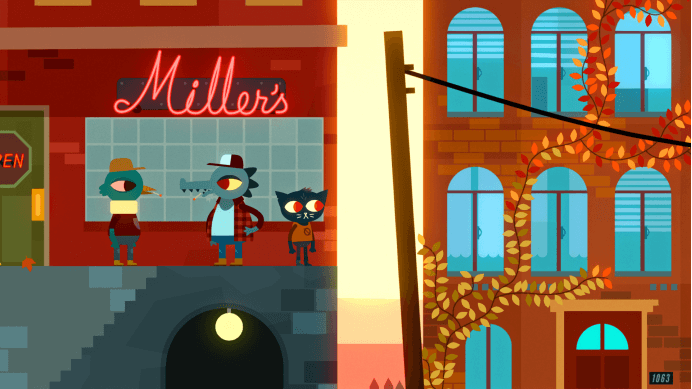
When I jumped over the rusty train tracks for the first time in the autumn town of _Night in the Woods_ and watched Mae wagging her fluffy tail in the sunset, I suddenly realized that this was not only an adventure, but also a love letter to the lost youth. This decaying mining town called Possum Springs has become a perfect metaphor for the spiritual difficulties of our generation.
The game opens with the return of college after school. Mae, who I played, returned to her hometown, but found that everything had changed. After childhood playmates were trapped at the supermarket cashier, some talked about the nothingness of the universe in the church cemetery, and the legend of “ghosts” echoed in the factory ruins of the town. But what really makes this animal kingdom alive is the philosophical discussions on the roof late at night, the improvised band in the convenience store, and the pizza money that can never be made — these seemingly trivial daily routines accurately capture the existential anxiety unique to the age of 20.
The most shocking narrative takes place in the chapter “Crack”. When Mae and her friends sneaked into the underground mine and found that the flashing strange lights were not supernatural, but the truth of the economic collapse of the whole town, the game suddenly changed from youth comedy to social allegory. Those “ghosts” that we regard as strange talk are actually the anger and despair of laid-off workers who have nowhere to put them.
The portrayal of mental health in games is heartbreaking. Mae’s anxiety attack will distort the screen vision, and the color will fade from the world when she is depressed. Once when she stood on the edge of the cliff, the game gave three options: “staring at the abyss”, “take a step back”, and “shouting at the void” — this simple choice made me pause for a long time in front of the screen, because it was too similar to the psychological struggle in reality.
With the deepening of the investigation, I found that there is sharp social criticism hidden in every absurd setting. The pastor who talks about the black hole theory in the church is actually questioning the belief system; the revolutionary team formed by supermarket employees is actually resisting the alienation of capitalism. The most wonderful thing is that on Halloween night, when all the characters put on masks to revel, Mae took off her — “Sometimes, disguise makes you see yourself clearly.”
At midnight after customs clearance, I turned out the high school graduation photo. Those faces that used to talk about dreams together are now scattered in different real cages. The cruelest gift of this game is that it makes you understand that growth is not about finding answers, but learning to coexist with problems.
If you are also wandering at the crossroads of life, _Night in the Woods_ will give you the warmest companionship. It won’t tell you where to go, but it will make you believe that even if you get lost, the scenery along the way is worth cherishing. After all, the essence of youth is never to arrive, but to know yourself in roaming.